Part 2: Data Desert
I remember sitting with my laptop open, long after the house had gone quiet.
Biopsy complete. Diagnosis confirmed. Surgery scheduled.
Now I wanted numbers.
Survival rates. Treatment outcomes. Recurrence statistics. I wanted something solid to hold on to. Something measurable. Something that felt like control.
Instead, I found qualifiers.
“Limited data.”
“Underrepresented populations.”
“Further research needed.”
Further research needed.
On whom?
On me.
When you are diagnosed with cancer, information becomes oxygen. You cling to it. You compare percentages. You calculate timelines. You search for stories that mirror your own.
But when you are BIPOC, you quickly learn that many of those numbers were not built with you in mind.
Clinical trials have historically underrepresented Black, Indigenous, Latino, Asian, and other communities of color. That means the research guiding treatment decisions often reflects a narrower slice of the population.
And when you realize that, something shifts.
The statistics feel less certain. The reassurance feels thinner.
You are no longer just asking, “What are my chances?”
You are asking, “Were people like me even included in this calculation?”
Representation in research is not symbolic.
It determines how drugs are tested.
How side effects are measured.
How dosing is calibrated.
How outcomes are predicted.
If your community is missing or minimally represented, the data guiding your care may not fully capture your lived reality.
That is not just a scientific issue.
It is a psychological one.
Because when the numbers do not clearly include you, it can feel like you are stepping into treatment alone.
I have spoken with countless BIPOC survivors who describe the same quiet moment.
They look at the charts. They read the studies. They search for demographic breakdowns.
And they realize they are navigating a system where their presence in the research is thinner than it should be.
It creates doubt.
Not always loud doubt. Not dramatic doubt.
But a steady undercurrent.
If we were not centered in the research, are we centered in the care?
If our outcomes were not deeply studied, are our experiences fully understood?
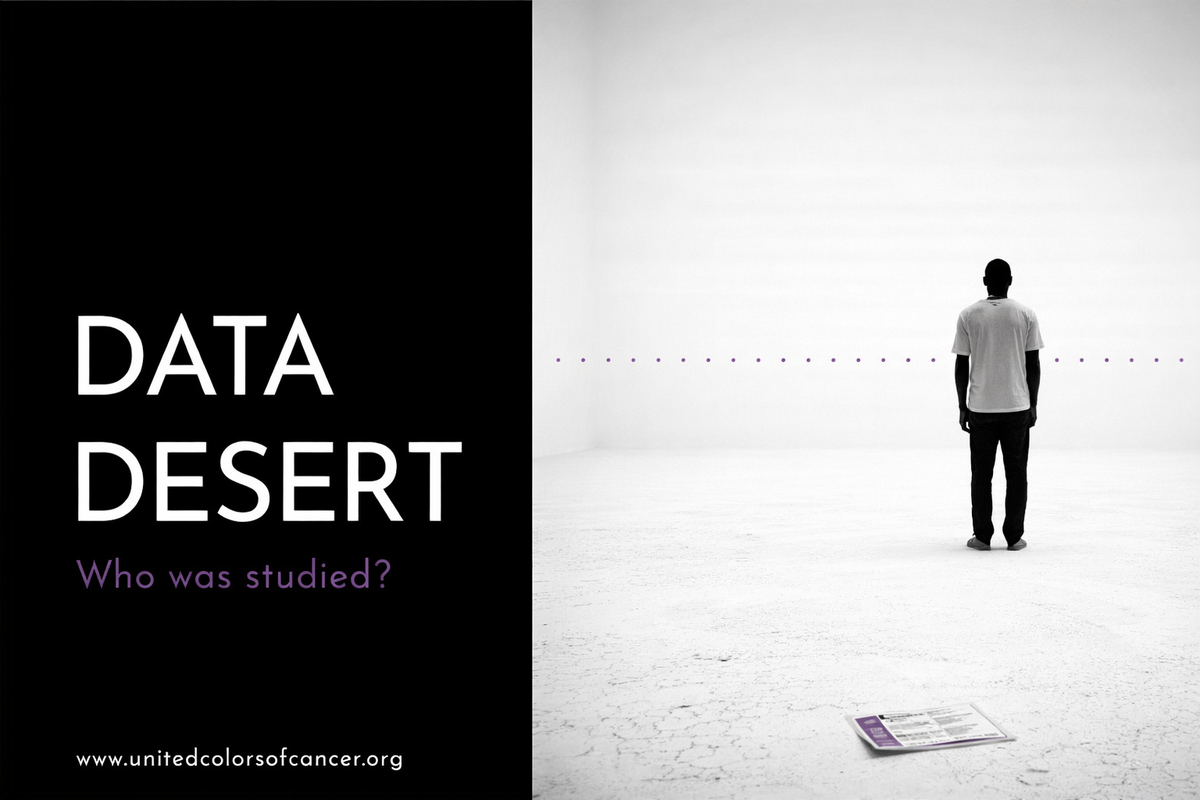
This is what I call the Data Desert.
A landscape where information exists, but not evenly.
Where breakthroughs are celebrated, but not always equitably tested.
Where entire communities are expected to trust science that has not always invested in studying them with intention.
Trust requires transparency.
And transparency requires representation.
The emotional toll of this invisibility is real.
Cancer already strips away certainty.
Data gaps compound that uncertainty.
You are making life altering decisions about surgery, chemotherapy, radiation, targeted therapies. Decisions that affect your body, your fertility, your future.
And you are doing so while quietly wondering whether the evidence base truly reflects you.
That is a heavy thing to carry.
This is not about rejecting science.
It is about strengthening it.
It is about asking why communities that bear disproportionate cancer burdens are still underrepresented in clinical trials.
It is about acknowledging that diversity in research is not a public relations strategy. It is a survival strategy.
Because representation in data is not cosmetic.
It is clinical.
And when BIPOC patients are fully included in research, treatment becomes more precise. Outcomes become more accurate. Trust becomes more possible.
The loneliness of being the only one in the waiting room is visible.
The loneliness of being underrepresented in research is quieter.
But it shapes decision making. It shapes confidence. It shapes peace of mind.
In Part 3, we will move from research to the exam room and talk about the subtle moments that compound isolation: the microaggressions, the dismissal, the small interactions that quietly erode trust.
Because the Data Desert is not the only terrain BIPOC patients must cross.
And the journey deserves to be fully seen.