Part 5: The Burden of Representation
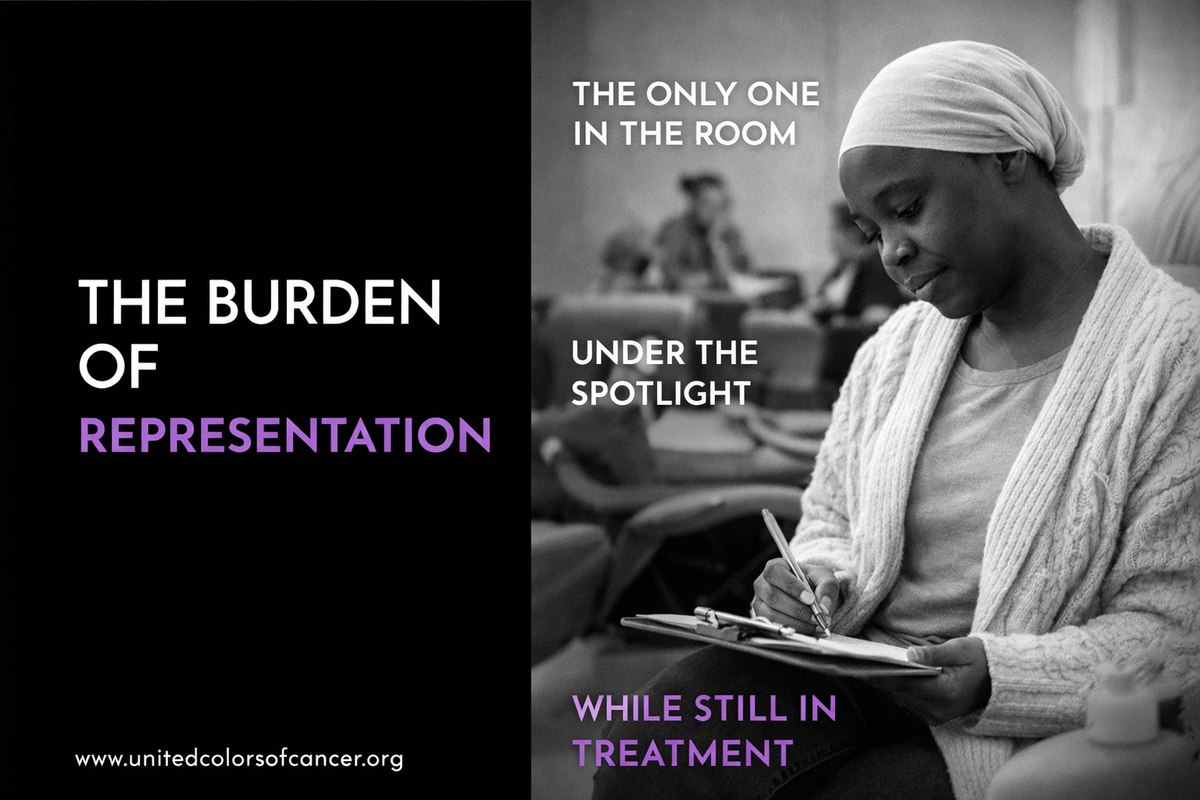
There is a moment that happens to many BIPOC cancer patients.
It does not happen at diagnosis.
It does not happen during surgery.
It happens when someone says, “We need more people like you in this space.”
And suddenly, you are not just a patient.
You are a representative.
When you are one of the few in the room, your presence feels amplified.
If you participate in a clinical trial, it is not just about your outcome. It is about “the community.”
If you speak up about bias, you are not just advocating for yourself. You are advocating for everyone who looks like you.
If you share your story publicly, it becomes symbolic.
There is power in that.
There is also pressure.
I have felt it.
The unspoken expectation that because I can articulate the problem, I must also help solve it.
The assumption that because I survived, I must now lead.
The invitations to sit on panels, join advisory boards, educate institutions, explain cultural nuance.
All while still healing.
All while still processing.
All while still navigating scans and follow ups and the quiet fear that never fully disappears.
Representation matters.
But representation without support becomes labor.
And too often, BIPOC patients are asked to do emotional and educational work while still in active treatment.
To recount trauma for awareness.
To translate lived experience into institutional insight.
To be the bridge.
Bridges carry weight.
There is also the internal pressure.
The thought that if you do not participate, you are letting your community down.
If you do not join the study, the numbers will never improve.
If you do not speak, the silence will continue.
So you say yes.
Even when you are tired.
Even when your body is still recovering.
Even when you just want to be a person, not a symbol.
Cancer is already a fight for your life.
The burden of representation turns it into a fight for visibility, equity, and systemic change at the same time.
That is too much for one body to carry.
Advocacy should be a choice.
Education should be compensated.
Storytelling should be supported.
No one in active survival mode should feel obligated to carry an entire movement.
And yet, so many of us do.
Because we know what it feels like to be invisible in the data.
Invisible in the waiting room.
Invisible in the narrative.
So we step forward.
Not because we are not tired.
But because we remember what it felt like to sit alone.
Cancer is hard.
Cancer while BIPOC often means surviving and advocating simultaneously.
It means healing while building.
It means carrying both your own story and the weight of collective experience.
In Part 6, we will shift toward something lighter but just as powerful: what happens when we find each other. When community replaces isolation. When shared experience becomes shared strength.
Because the burden of representation is heavy.
But community distributes the weight.